Related Technologies
To evaluate the feasibility of a smart lanyard, we reviewed current wearable technologies that integrate sensors, displays and wireless communication.
Smart badge hardware
- Microcontroller‑based badges – Sociometric badges used in workplace interaction studies combine microphones, accelerometers, infrared sensors and CMOS cameras with wireless radios such as Bluetooth. They can run lightweight operating systems and send data to a server for analysis.
- E‑ink employee badges – Commercial badges like the Seekink T037D feature a 3.7 inch E‑ink display, Bluetooth 5.1 and 4G connectivity, NFC wireless charging and encryption. They are waterproof and offer long battery life.
- Face‑recognition kits – Development kits such as NXP’s EdgeReady i.MX RT106F combine infrared and RGB cameras with a microcontroller to perform on‑device face recognition and liveness detection. They provide Wi‑Fi/Bluetooth/Ethernet connectivity and optional displays.
- AI voice recorders – Pocket‑sized recorders like the Plaud Note Pro house four MEMS microphones, 64 GB of storage and a voice processing unit for noise cancellation. They offer AI‑powered transcription and templates for meeting notes.
Hardware components
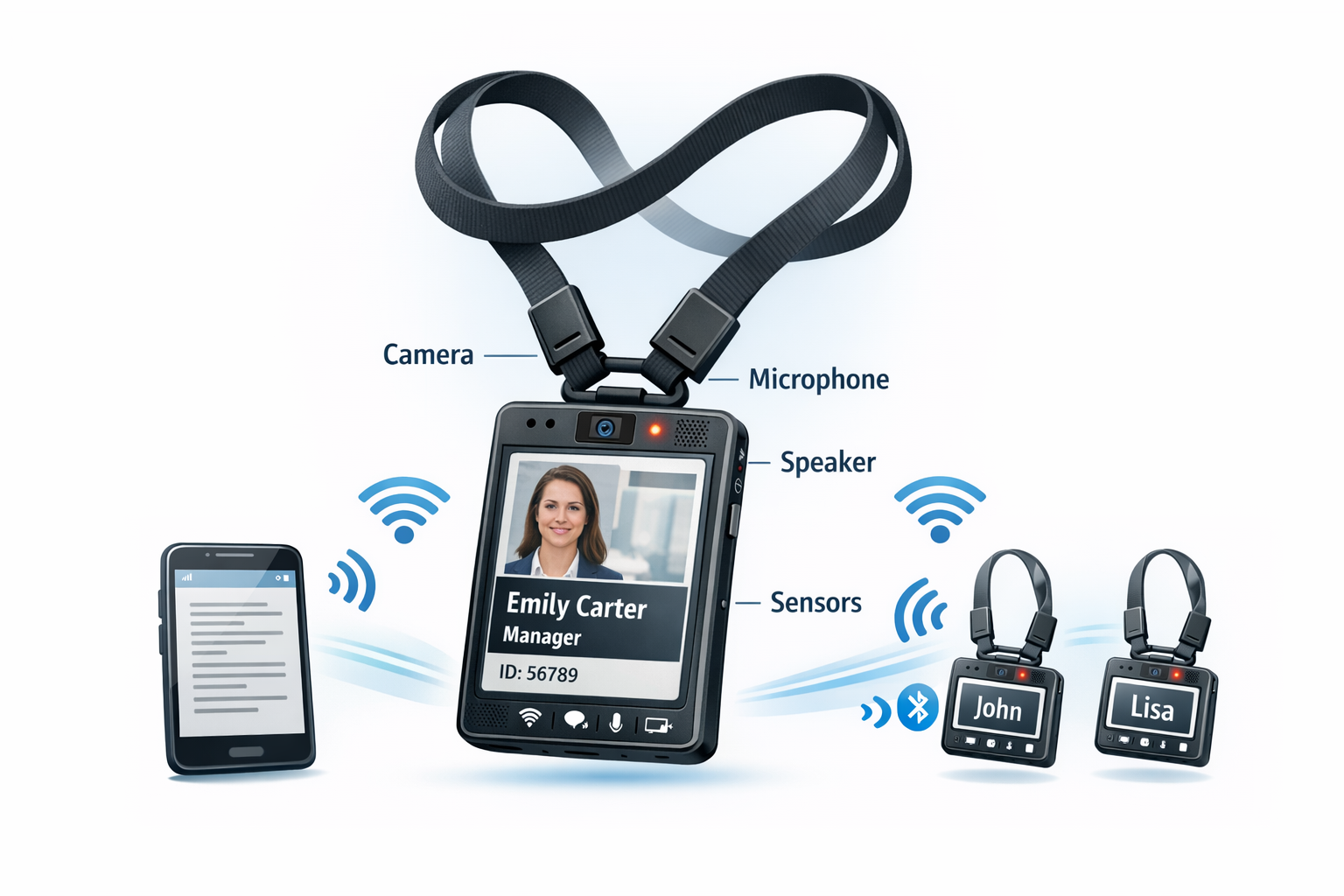
The smart lanyard combines several hardware modules to provide identification, communication and note‑taking functionality.
| Component | Purpose/Features | Design notes |
|---|---|---|
| Microcontroller with edge‑AI | Central processing unit for facial and voice recognition; includes Wi‑Fi/Bluetooth. | Select a microcontroller with sufficient memory and secure boot capabilities to run face, voice and gait algorithms. |
| E‑ink or OLED display | Shows the wearer’s name, photo and status while consuming minimal power. | E‑ink offers long battery life; OLED provides color but uses more power. |
| Camera module | IR and RGB cameras for facial recognition and liveness detection. | Low‑power cameras should integrate with the microcontroller and include a privacy shutter. |
| Microphones & speaker | Multi‑microphone array for far‑field voice capture; speaker for audible greetings. | A four‑microphone array improves noise suppression; a small speaker provides feedback and alerts. |
| Accelerometer/Gyroscope | Captures body dynamics (gait) for secondary identification. | Use lightweight IMUs and combine gait features with facial recognition for multi‑factor authentication. |
| Optional heartbeat sensor | Measures unique cardiac signatures to add another authentication layer. | Requires skin contact (e.g., on a wrist strap); may be optional due to complexity. |
| Wireless modules | Bluetooth 5.x for badge‑to‑badge and smartphone communication; Wi‑Fi for data syncing; NFC for wireless charging. | Bluetooth LE supports peer‑to‑peer updates; Wi‑Fi is used when the badge is near a computer or phone. |
| Battery and charging | Rechargeable battery providing long life and wireless charging capability. | Use battery‑management circuitry and enable energy‑saving modes. |
Concept Illustration
The concept art below visualizes a smart lanyard with a display, camera, microphones, speaker and wireless connectivity.